
By 1915, the Old Head Signal Tower was in ruins, however it remained a silent sentinel at the highest point of the headland, bearing witness to one of the most consequential maritime tragedies in history.
At 2:10pm on Friday 7 May 1915, RMS Lusitania was torpedoed by a German U-Boat on her starboard side. The ship listed immediately making it incredibly difficult to safely launch lifeboats. The Lusitania sank in just 18 minutes, resulting in a devastating loss of life within sight of the Old Head of Kinsale. The following telegram received by the press association appeared in a number of newspapers, including the Daily Express on 8 May 1915:
'It appears the Lusitania was noticed to be in difficulty from the Signal Station at the Old Head of Kinsale at 2:12pm. At 2:33 she had completely disappeared.'
The Lusitania sank just under 12 miles south of the Old Head of Kinsale, making it the closest landward point to the tragedy. The Signal Station referred to the Old Head Coastguard Station, which was located where the Old Head Golf Links Clubhouse currently stands.
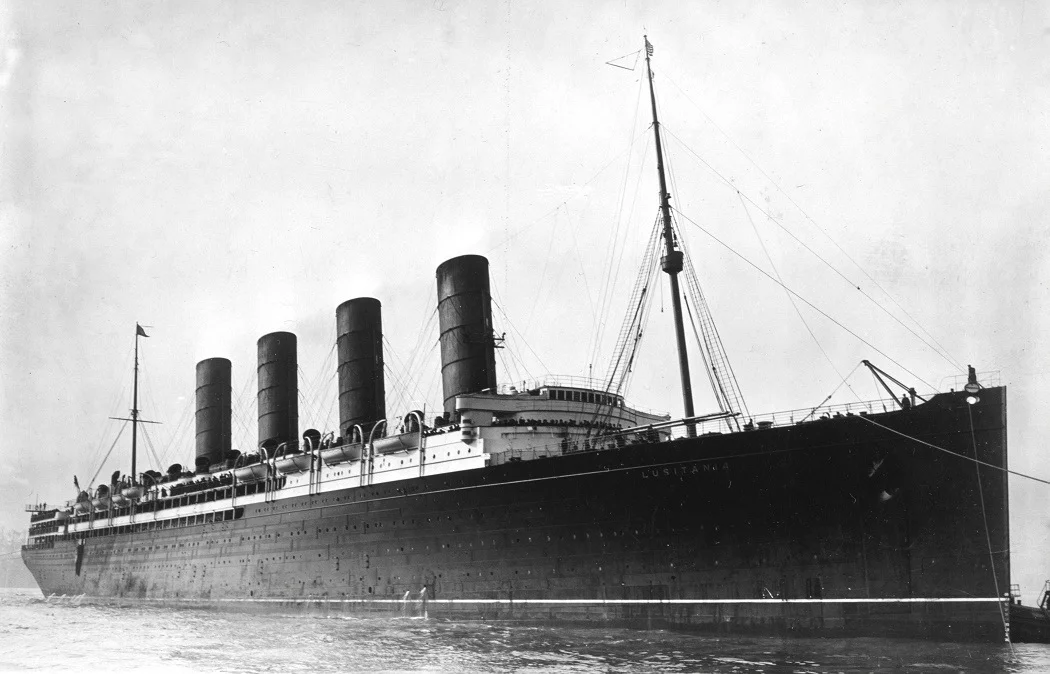
RMS Lusitania was built by John Brown & Company in Clydebank, Scotland. Construction began in 1904 and the ship was launched on 7 June 1906. At the time of her launch, Lusitania was the largest ship of her kind in the world.
RMS Lusitania, and her sister ship RMS Mauretania, were Cunard liners which were constructed to reclaim British dominance on the transatlantic route. The early 20th century was a highly competitive time for the passenger liner industry. It was a case of national pride that these new liners would rival German competitors, Deutschland and Kaiser Wilhelm II, and achieve the Blue Ribband, the prestigious prize for the fastest transatlantic liner. Consequently, Cunard received a loan from the British Government of £2.6 million towards their construction. There were conditions attached however; the ships would need to be built to facilitate revolving gun placements and be able to achieve unbeatable speeds. The ships could also be commandeered as armed merchant cruisers or troopships during wartime if necessary.
We are now working towards the final phase of our project - to build a dedicated Lusitania Museum building.
DONATE